
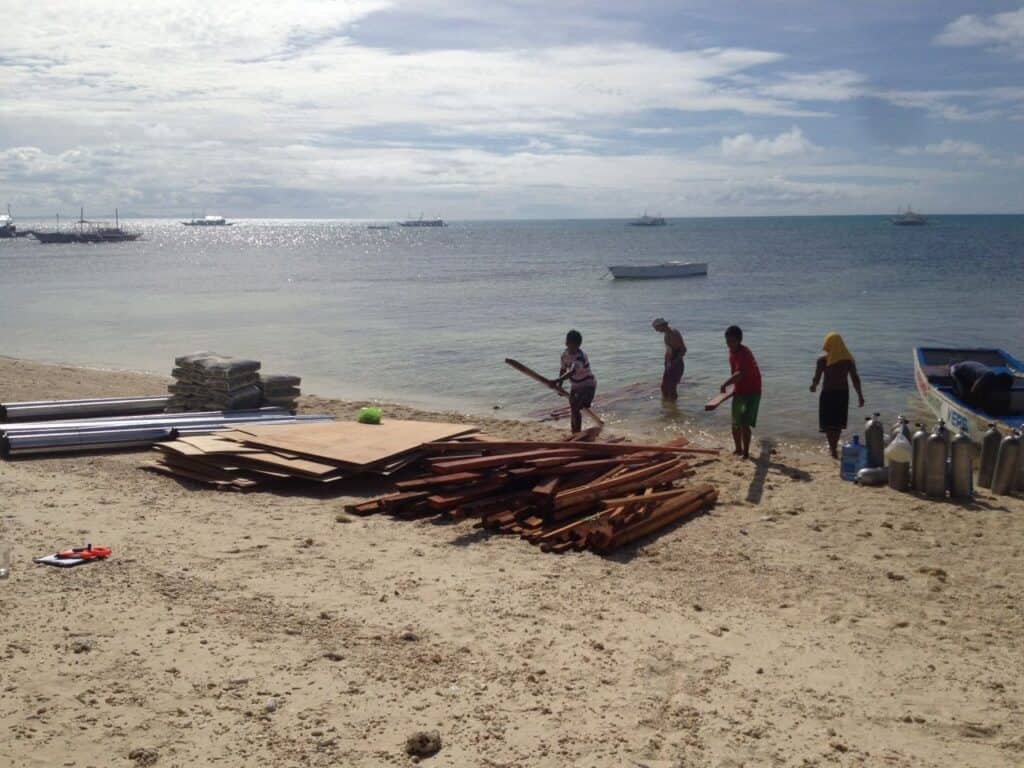
On November 8, 2013, Typhoon Haiyan hit the Philippines. It was the strongest storm ever recorded at landfall. Malapascua took a direct hit.
The roofs came off. Trees snapped. The boats were scattered. The island that morning looked like a warzone, and for the people who lived there, including our staff and their families, it was.
Nobody died on Malapascua. That’s the first and most important thing. In a typhoon that killed over 6,000 people across the Philippines, our tiny island got through without losing a single life. Luck, geography, and the fact that most of the concrete structures held. But the damage was enormous.
WHAT HAPPENED NEXT
Within 24 hours, we launched a fundraiser. Within 14 hours of posting the link, donations had already passed PHP 100,000. Within a week, it was over $20,000 USD. Within two weeks, $55,000. By the time we stopped counting, the total from all sources was well into six figures.
We were blown away. Literally and figuratively.
The money came from divers who’d visited us, people who’d never been to Malapascua but wanted to help, and complete strangers who just saw the appeal and gave. A rock concert was organised in Portsmouth, UK. Groups of returning guests arrived carrying envelopes of cash they’d collected back home. Our Thai regulars from Bangkok, led by Ana and Warong, showed up for their annual holiday with donations they’d gathered from their dive community.
WHAT WE DID WITH IT
Every peso went to the locals, not the businesses. That was the rule from day one. The dive shops and resorts could rebuild themselves. The staff who earned modest wages and lived in wooden houses could not.
We rebuilt homes. Every single one of our staff had a new or repaired house by Christmas 2013. We bought over 10,000 items of school supplies, delivered in 70 boxes to the 1,100 children at Logon Elementary School. Then we took on the rebuilding of the school itself, managing the project and using the donated funds to replace what the typhoon destroyed.
By early December 2013, TSD was back in full operation. Globe Telecom restored cell coverage within two weeks. The internet followed. The road from Cebu to Maya was cleared. The boats were running again.
THE SHARKS
Here’s the thing nobody expected. Two days after the storm, our instructors went out to check the dive sites. The house reef was damaged. Our whale shark Biorock structure had vanished. The manta structure was crushed.
But the marine life was thriving. Better than normal, in fact. Plentiful reef fish, frogfish, scorpionfish. The coral was not badly affected. And the thresher sharks at the shoal? They didn’t miss a day.
Nature is more resilient than we give it credit for. So are the people of Malapascua.
ONE YEAR ON
Twelve months after Haiyan, the island was back. Not the same as before; better in some ways, scarred in others. The school was rebuilt. The homes were repaired. The dive sites had recovered remarkably. Tourism returned, cautiously at first, then fully.
Malapascua means “Bad Christmas” in Spanish, named after a storm in the 1500s. The name felt grimly appropriate in 2013. But that Christmas, with every staff member in a new home and the dive shop full of returning guests, it felt like something else entirely.
We don’t dwell on Haiyan. It happened, we dealt with it, we moved on. But we’ll never forget the generosity of the diving community. If you donated, volunteered, or simply came to dive with us in those early months when tourism was fragile: thank you. You rebuilt this place as much as we did.