
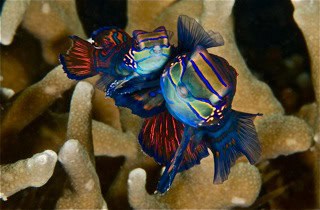
Everyone talks about the thresher sharks. Fair enough. But ask any underwater photographer what they came to Malapascua for, and there’s a decent chance they’ll say mandarin fish.
These tiny, psychedelic fish are arguably the most beautiful creatures in the ocean. About the size of your thumb, painted in swirls of electric blue, orange, and green, they look like someone designed them specifically to be photographed. And every evening, just as the sun dips below the horizon, they put on a show.
WHAT HAPPENS
Mandarin fish (Synchiropus splendidus, if you want to impress someone) spend their days hiding in coral rubble and dead staghorn coral. They’re almost impossible to spot during the day. But at dusk, they emerge to mate.
The males display for the females, spreading their oversized pelvic fins and doing a sort of shimmy. When a female is impressed, the pair rises together off the reef, belly to belly, and releases eggs and sperm simultaneously into the water column. The whole act takes about five seconds. Then they descend back into the rubble, and the cycle repeats.
It’s bizarre, beautiful, and weirdly moving. The first time you see it happen a foot from your mask, you understand why people fly halfway around the world for this.
WHERE AND WHEN
Our mandarin fish site is at Lighthouse Reef, right off Malapascua. It’s a shallow dive (3 to 7 metres), which means it’s accessible to divers of all levels and you’ll never run low on air. The dive starts about 30 minutes before sunset and lasts around 45 minutes.
Your guide will know exactly where the mandarin fish hang out. They’re territorial and use the same rubble patches repeatedly, so the sighting rate is very high. On a typical evening, you’ll see multiple pairs and multiple mating events.
PHOTOGRAPHY TIPS
If you’re shooting: macro lens, obviously. The challenge is twofold. First, mandarin fish are small and they don’t sit still for long. Second, the light is fading. You’ll need a good strobe and patience. Use a red focus light rather than a white torch; the mandarins are less spooked by red light.
Resist the urge to chase them with your torch. A panicked mandarin fish retreats into the rubble and won’t come back out. Let your guide position you, stay low, breathe gently, and wait. The fish will come to you.
Some of the best mandarin fish photos we’ve seen were taken by divers on their very first macro photography dive. Beginner’s patience, as it turns out, is an asset.
WHAT ELSE YOU’LL SEE
Mandarin fish are the headline act, but the twilight reef is full of other oddities. Expect to see painted frogfish, robust ghost pipefish, various seahorse species, and a parade of nudibranchs. The night shift changeover, where daytime fish bed down and nocturnal hunters emerge, is fascinating to watch.
After the mandarins finish their mating ritual, we usually continue the dive as a night dive. Switch on the torches, and the reef transforms. Octopuses hunting, crabs fighting, shrimp with reflective eyes lining every crevice. It’s like a completely different dive site.
We run the mandarin fish dive every evening, weather permitting. It’s included in your diving package, not an expensive add-on. If you’re spending more than one night on Malapascua, there’s no reason to miss it. See our dive packages at thresher-shark-divers.com.