
There’s a category of diving where the whole point is finding things that are trying very hard not to be found. Creatures that look like rocks, sand, seaweed, or other creatures entirely. It’s called muck diving, and Malapascua happens to be spectacular at it.
If you’ve only ever dived coral reefs and walls, muck diving might sound underwhelming. A sandy bottom? Rubble? Where’s the drama? The drama is in the details. Once your eyes adjust and your guide starts pointing things out, you realise you’re surrounded by an absurd variety of life that you were literally looking straight at without seeing.
WHAT WE FIND
Seahorses. Malapascua has multiple species, including the tiny pygmy seahorse (less than 2cm tall, living on gorgonian fans, essentially invisible until someone points at it). Also thorny seahorses, common seahorses, and the occasional robust ghost pipefish, which is technically a relative.
Frogfish. These are the masters of disguise. A painted frogfish can sit on a sponge, perfectly colour-matched, and you will stare directly at it without seeing it. They hunt by dangling a lure above their mouth and waiting for a curious fish to investigate. When the prey gets close enough, the frogfish strikes in approximately 6 milliseconds. It’s one of the fastest predatory actions in the animal kingdom, and it comes from something that looks like a stressed potato.
Blue-ringed octopus. Tiny, beautiful, and among the most venomous animals in the ocean. They flash those iridescent blue rings when agitated. We find them regularly on our night dives. Your guide will point, you’ll look, and your heart rate will briefly spike. Perfectly safe to observe. Don’t touch. (You shouldn’t be touching anything underwater, but especially not this.)
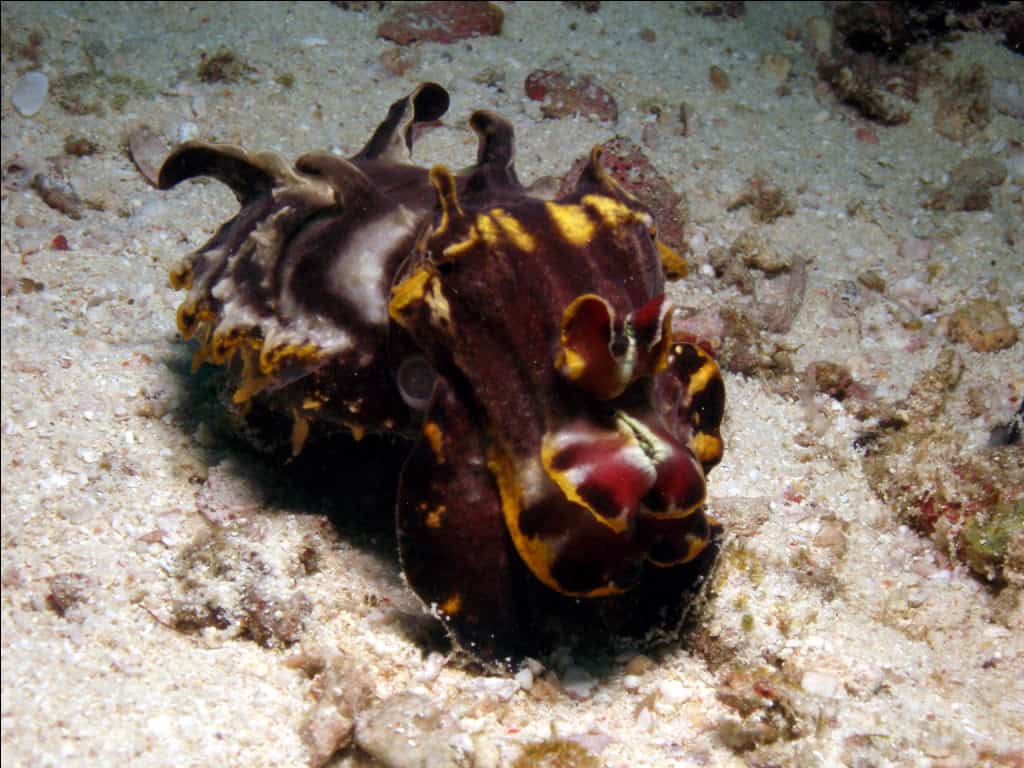
Flamboyant cuttlefish. Another impossibly colourful creature that “walks” along the sandy bottom using its arms. Unlike other cuttlefish, flamboyants are actually toxic and can’t swim well, which is why they strut around on the seabed like they own the place. They do, frankly.
Nudibranchs. Malapascua has dozens of species. These shell-less sea slugs come in every colour combination imaginable and are the undisputed darlings of underwater macro photography. Some are common, some are rare, and finding a species you’ve never seen before is a small thrill every time.
WHERE WE DIVE
Lighthouse Reef (our house reef) is the primary muck site, and it’s excellent. Easy access, shallow depth (3 to 12 metres), and our guides know every square metre. They know which rubble pile the frogfish has been living on for the past month, which gorgonian has the pygmy seahorse, and where the mandarin fish emerge at dusk.
We also find excellent muck critters at Chocolate Island and around the edges of some of our reef sites. The great thing about muck diving in Malapascua is that you don’t need to travel far or dive deep. Some of the best finds are in 5 metres of water, 100 metres from the beach.
WHY IT MATTERS
Muck diving develops your eye. It teaches you to slow down, look closely, and notice the small things. Divers who do muck dives become better divers generally: better buoyancy (because you’re hovering over sand and rubble, trying not to disturb anything), better air consumption (because you’re relaxed and observant, not finning around searching for big stuff), and more attuned to the reef.
It’s also endlessly surprising. On any given muck dive, you might find something genuinely rare. That’s the hook. You never know what’s hiding in the rubble.